Export > Cement Boards

Knauf AQUAPANEL® Exterior Wall System

The new pioneering Knauf AQUAPANEL® exterior wall system integrate the evolution brought into the building industry by the drywall systems. The engineer is now able to employ certified structural elements to complete any type of load bearing structure safely, in a cost and time effective manner. Every requirement for sound and thermal insulation, fire protection and earthquake resistance are met in the most efficient way.
The Knauf AQUAPANEL® exterior wall system are applied successfully in buildings consisting of concrete, metal or wood. The low weight (from 30kg/m²) of the wall results in reducing drastically the dead loading of the load bearing structure and contributes to the diminution of the seismic loading of the building.
The advantages of the Knauf AQUAPANEL® exterior wall system are unique. It is ideal for use in any kind of construction, new or old, apartments, business centres, hotels, domestic buildings, industrial buildings. Also adaptable for fences, fireplaces fronts, mobile home skirting, agricultural buildings, UL-listed wall shield/floor protectors, garage wainscoting and exterior chimneys. Knauf is offering the possibility of constructing the whole building, internally and externally, with complete systems of cement boards and gypsum boards, multiplying the advantages of the fast construction, conformability and cost efficiency.
Knauf technical support team is capable to discuss with you the construction details of your application and offer assistance on system design, product selection, specification details and installation details all over the Greek territory. The Knauf AQUAPANEL® exterior wall system is distributed in the Greek market by the extensive commercial Knauf network. The qualified contractors, who are trained in the modern training centre of Knauf are constantly informed, and are capable of properly installing the system in terms of quality and efficiency.
Metal Framework TYVEK Stucco Wrap

Knauf AQUAPANEL® plus have to be fix in Knauf stud CW 75 or CW 100 with Knauf screws of wafer-head in a maximum distance of 400mm. The investigator has to chose the appropriate cross-section therefore the deformation of the metal framework will not excite L/360 with respect of the wall high. Alternative for high wall systems is recommended of using UA 2mm metal studs. In respect to the cases of open areas (windows, doors) in the wall system, the use of the Knauf reinforcement metal stud UA 2mm is a necessity (secure to the structural floor and roof with the specific fixing corners).

TYVEK Stucco Wrap is a special weather resistant barrier engineered to improve the effectiveness of AQUAPANEL® Wall External System. The engineered surface texture helps alleviate moisture build-up. Water that gets behind the exterior wall surface is channelled down the wall. Provides necessary protection to keep moisture away from water-sensitive sheathing products. The excellent weatherability and durability make it not to rot or absorb water and retain its strength when exposed to moisture. The TYVEK is available is a rolls of 1.5m wide and 61m long.
Cement - Board AQUAPANEL® Jointing

The cement-boards have to place horizontally with the smooth side facing the framework and the raff side facing outwards. Knauf screws with wafer head are used for fixing the cement-board on the framework. They have to be screw so that the underneath head of the screw is in contact with the cement-board and in a distance of 15 cm. The vertical jointings have to be support with studs. The jointings have to be crossed as usual. The creation of vertical and horizontal jointings in the continuation of the open areas is not allowed. Between the cement-boards have to be a distance of 1 to 2 mm.

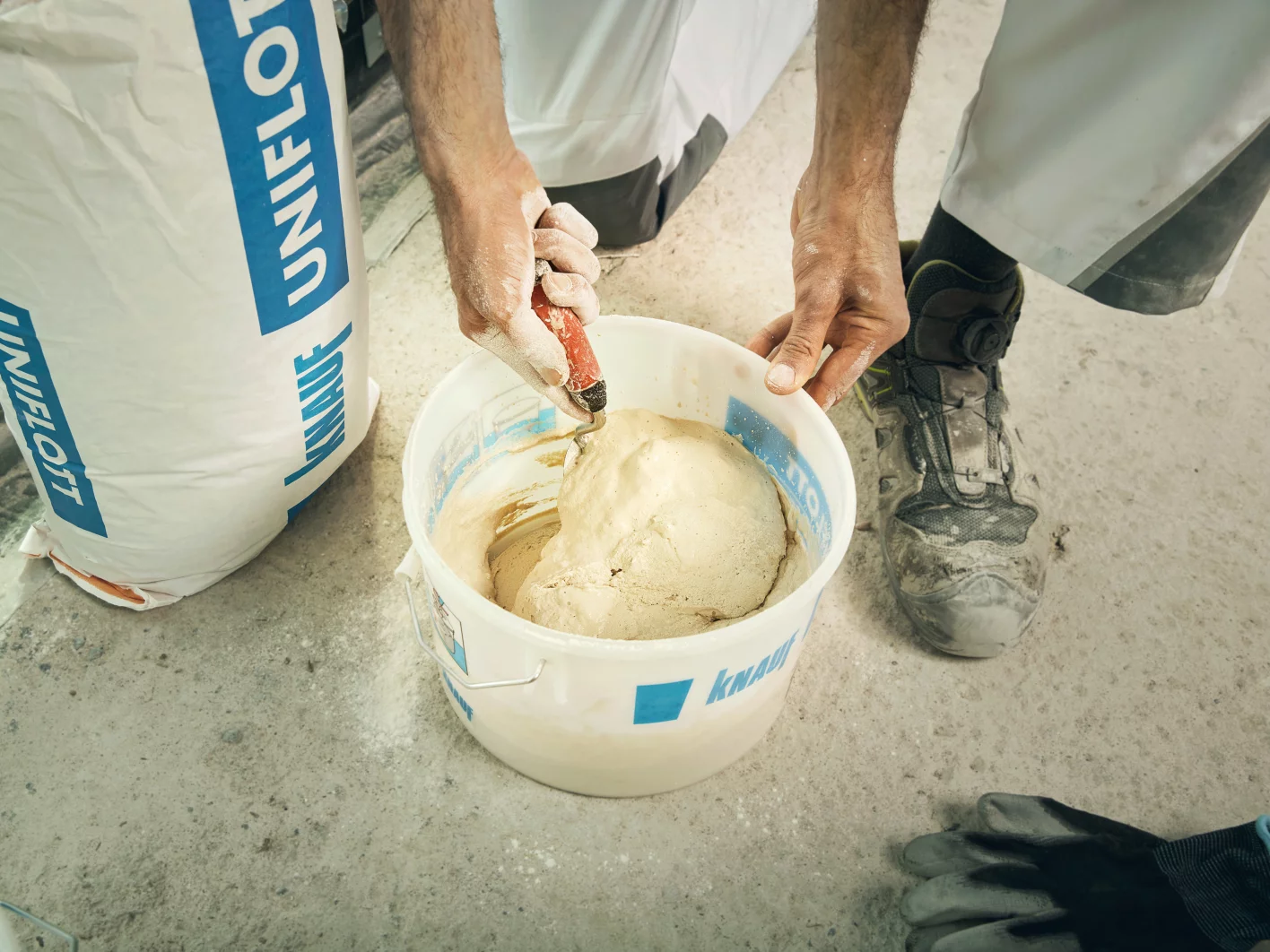
The constructions of jointings and basic plaster are made with the mixing of the same volume of Portland type II and aggregate of Betocoat. The mixing is made with stirring machine with out the use of water or any other liquid or solid aggregate. The jointings are fill with the ready compound and are reinforce with the use of Knauf anti-alkali fibreglass tape and bedded.
Basic Plaster Decorating Plaster or Paint

The basic plaster consist the main component for the aesthetic, the durability and the moisture resistance of the system. The fitting of the system according to the directions of the produces is vital. The fitting of the basic plaster has to be done 4 hours after the jointing. The mixture is spread in the surface of the cement-board with the use of toothed spatula (6x6 mm). Immediately after the grid is place with the concave side facing the wall in the still moist plaster and is level with a wide spatula until is fill completely. The grid has to be completed 5cm in the jointings and 20cm in the corners. The square of the grip should not be visible after the end of the fitting. The minimum width of the basic plaster has to be 2.5 to 3 mm.

In any case the basic plaster has to be prepare with the use of Knauf Tiefengrund or Primer Elast, that will ensure good adherence and homogenous mixture in the absorption of the base. Following that either the Color Elast is placed with the use of roll or the Exterior texture finish with the use of spatula. That process has to be done 24 hours after the basic plaster is fitted.


GOOD DESIGN - PRACTICES
1. System response 2. Expansion Jointings
The detail designs, the specifications and the givens in the printed maters have to be use as a general guide for the Knauf external wall systems. The presented informations have to be used only in a relation with the Knauf external wall systems. The natural properties of competitive products may be different. Knauf is not responsible for any failure that may follows from the usage of other material or from the wrong fitting of the Knauf exterior wall systems. The choice and the design position, of width and details of the expansion jointings are responsibilities of the designer. Knauf is not recommending the use of galvanised metal in the expansion jointings. Expansion jointings have to be created were there are expansions jointings in the building, where there are important interrupts in the building or when ever there are different materials. Fundamentally as a rule expansions jointings are predicted in a distance of 6 meters vertically and horizontally. In case that verticals expansions jointings cross with horizontal ones the verticals have to be in a continuations and the horizontals have to be interrupted.
3. Opening of doors and windows. 4. Limitations in Installation process
The penetrations of water in the internal structural elements from wrong details assemblage of watertight constructions in the doors and windows is very usual. It is crucial a great importance to be given in the construction, therefore this possibility would be avoided. It is also important details that trap water to be avoided. The instructions of the producer of openings (doors, widows) and the instructions of Knauf have to be followed. The building of jointings, the installation of basic plaster, the placement of the reinforcement grid and the installation of texture finish should not carry out in temperatures below 4 oC not in frozen water condition or with frost. After those procedures carry out, the surfaces have to be protected effectively from rain, humidity, and temperatures below 4 oC. Atmospheric conditions of high temperatures and low humidity follow a decrease in the working time of the cement mortars. In those condition the saturation of the system may improve the working conditions.
5. Shadows - notations 6. Storage - Treatment
When the external temperature of the building is significantly difference from the internal, there is the probability of dust travel through air to concentrate in the coolest areas of the external wall system, especially in the areas of framework and jointings. This is a natural phenomenon and it doesn't related with a failure of the system. Also any scaffoldings have to be removed immediately after the paining or after placing the finish coat therefore not to contribute in shadows from dissimilar dryness of colour. Cement-boards are packed with a plastic wrapper. They have to store internally or covered with a clean surface hence to be protected from accidence or weather effects. If wooden blocks are used they have to be in a distance of 450 mm. Board of 6mm of width or less have to place in a uniform surface and not to be stored in a wooden blocks. They don't have to be lifted from the front side or transfer horizontally. They have to be transfer vertically, two persons have to support the backside and hold the front side therefore breaks may be avoided from the bending of the board.
Εκτυπώστε αυτή την σελίδα